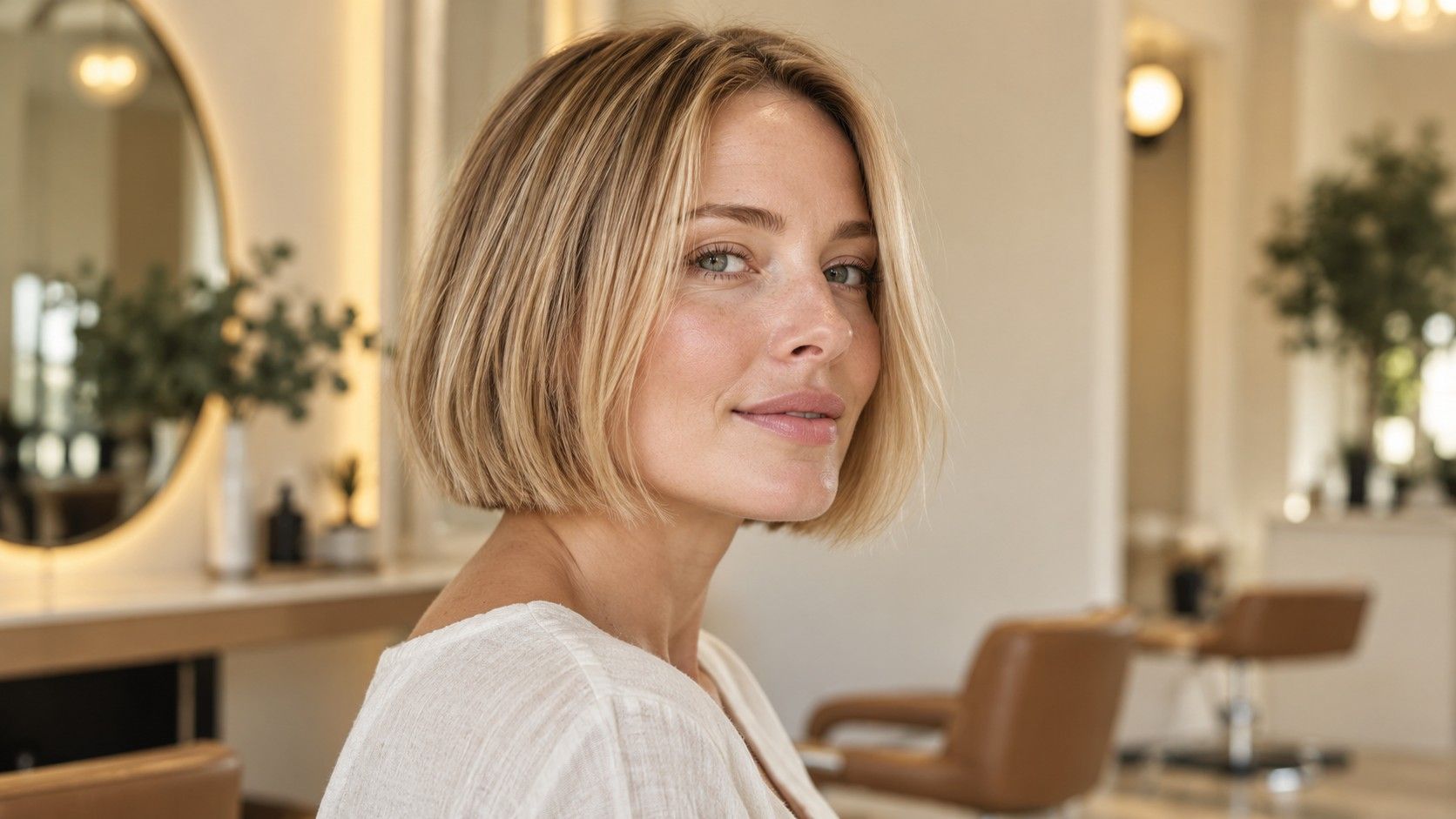
The French bob haircut is usually shown as a short, compact shape with a relaxed finish, often accompanied by a fringe. That description leaves plenty undecided. A cheekbone-length crop with a short fringe feels quite different from a chin-grazing bob with an open forehead. Before saving another photograph, decide what attracts you: the exposed neck, the movement at the ends, the fringe or the small amount of hair around the face. You can keep those qualities while adjusting the cut to the way your own hair falls.
Translate “short” into an actual stopping point
Look at your reference without concentrating on the model's face. Where do the ends land relative to the mouth, jaw and ears? Is the head tilted, making the front appear shorter? Is one side tucked? A haircut name is too broad to answer those questions. In the chair, point to the length you want while sitting upright, with your chin in a comfortable position.
The nape deserves its own discussion. You may want a clear neck while preferring longer pieces around your mouth, or a level outline all the way around. Ask to see how the proposed back connects to the sides. A very compact back can feel unexpectedly exposed if your references only show the front. It can also affect which sections will stay in a clip when you are working or exercising.
If this is a substantial change from long hair, agree on the shortest acceptable dry length before the cut starts. A cautious first version can still feel distinctly short. Leave room for the way a wave turns upward or a curl contracts as it dries. A photograph cannot tell a stylist exactly how much your hair will rise, so the final length should be checked on your own texture.
Choose the fringe with your hairline in view
A fringe can provide much of the look associated with a French bob, but it is optional. The right decision depends partly on whether you want hair on your forehead and how willing you are to arrange it. Show the stylist your natural part and any section that pushes up or separates at the front. A photograph of your hair after an ordinary wash can reveal behaviour that a freshly styled arrival hides.
A short fringe has less length available to bend or push aside. A longer fringe may offer more flexibility, though it can fall into your eyes or need a different shape as it grows. Ask how the proposed fringe will dry without a brush, and what it takes to restore it after sleep. “Wash and go” is not a precise promise; a quick front-section reset may still be part of the routine.
Bring your glasses if you wear them regularly. Check the fringe against the frame while looking down as well as straight ahead. Also consider how much forehead you want visible when the rest of the hair is tucked. The most useful reference shows the actual fringe edge clearly, without a hand lifting it or a strong breeze changing its position.
Work with the texture you have on most days
Loose waves can give a short outline a bent, airy edge. Straight hair may show the cutting line more clearly, while curls can make the same nominal length appear rounder and shorter. None of those textures disqualifies the style. They do mean that copying a reference strand for strand is unlikely to be useful. Ask which element of the photograph can be carried over and which part needs adapting.
On dense hair, discuss where weight will remain and where it might be reduced. Removing too much can change a firm outline into separated ends; leaving all the weight in place may create more side volume than you want. On finer hair, a clean perimeter may help the ends read as a continuous shape, but that does not determine whether you need layers. The stylist should assess the density and movement in your actual hair.
| Your usual finish | A useful reference detail | A question for the stylist |
|---|---|---|
| Straight and air-dried | A visible outline with little added bend | How will the ends sit without a brush? |
| Soft natural waves | Waves that bend at a similar height | Where should the dry perimeter land? |
| Defined curls | A comparable curl pattern and side volume | How will shrinkage affect the fringe and nape? |
| Usually smoothed with heat | The shape shown from the back and sides | How different will it look on an unstyled day? |
Reference photographs are most helpful when their texture resembles your everyday finish. A heavily curled photograph may show an outline that disappears when the hair is straight. If you like both versions, explain that you plan to wear both and ask how the cut will accommodate them.
Test the idea against a rushed morning
Picture a specific weekday: you have slept on the back, the fringe has separated and there is little time before leaving. Which steps would you actually do? A quick rewetting of the front may be manageable. A full blow-dry may not. Tell the stylist that difference before agreeing to a shape that depends on smooth roots and a carefully turned-under edge.
Ask for the finish to be demonstrated with the tools you own and are comfortable using. If you air-dry, ask what the silhouette will look like without the salon's brush work. If you diffuse waves, discuss how to avoid turning the drying process into an unfamiliar routine. Product suggestions should have a clear purpose, such as supporting the bend or controlling flyaway ends; the haircut should not require you to buy an entire shelf to understand it.
Tucking one or both sides can provide a quick change, but test whether the proposed length actually reaches behind your ears. Very short sides may spring forward again. A small clip can help, though it changes the outline and may not suit every setting. This is a practical detail worth resolving in advance if keeping hair away from your face is part of your working day.
Know what precision you are willing to maintain
A very short fringe and a crisp nape can make small amounts of growth noticeable. A softer outline with a longer front gives a different margin before you feel the shape has changed. Rather than choosing a salon interval first, ask what part of this particular cut is likely to need attention earliest. The answer may be the fringe even when the rest of the bob still feels comfortable.
Clarify whether fringe adjustments and full reshaping are separate appointments at your salon, and ask for the current booking details directly. There is no universal price or timetable for keeping a French bob in shape. Your growth, the original length and your tolerance for a softer outline all affect the practical schedule.
Growing the cut later deserves a short conversation, too. A short, level shape may pass through a stage where the ends catch against the jaw or neck, while a very short fringe takes time to become a sweepable front section. Ask which parts would be left alone and which would be refined during growth. Knowing the likely next step can make a bold initial cut feel easier to manage.
Keep the reference mood and change the details
You do not need a particular face shape to ask for this haircut. The useful choices are visual and personal: how much cheekbone or jaw you want exposed, where you like volume, and whether you prefer the face framed closely or left more open. Try moving your current front pieces inward and outward in the mirror. That small comparison can tell you more about your preference than assigning your face to a fixed category.
A virtual hairstyle preview can help compare the broad proportions of a shorter outline or fringe. Treat the rendered hair as a sketch. It cannot establish how your crown grows, how the nape will sit or how much work the reference requires. Take an image you like to the consultation, then let the assessment of your real hair determine the cutting details.
Before the appointment begins, summarise the request in plain terms: the dry length at the front, the amount of neck you want exposed, the fringe you can live with and the time you will spend styling. Add a photograph of a version that is too short if there is a firm boundary. A small set of clear decisions is more useful than a large collection of loosely related short bobs.
After the cut, save a photograph once you have styled it yourself. Note anything specific that feels awkward, such as the left side refusing to tuck or the fringe resting on your glasses. Those are workable adjustments for a later visit. The aim is a compact haircut whose proportions you enjoy through an ordinary week, with enough flexibility to feel like your hair rather than a reference you must reproduce each morning.